
TREAT News
DRY SEASON JULY TO SEPTEMBER 2026
IN THIS ISSUE
(Items are included in TREAT News for their interest to members and do not necessarily express TREAT's views)
COMING EVENTS
Date Time Event Location
Saturday 22 August 2026 2.00 pm Field Day RN 1691 Topaz Road
Friday 4 September 2026 7.00 pm AGM Yungaburra Community Hall
Field Day at Freebrook
A TREAT field day at Kylie Freebody and Larry Crook’s property that was scheduled for August 2023, needed to be cancelled due to wet conditions, but this year we expect it will finally happen.
The major plantings of 11,400 trees stretch over a period of 13 years, from 1995 to 2007. Extra plantings since have taken the total trees planted to 13,100. The now forested area covers 4 hectares of land that was disused pasture and incorporates the previous Topaz sports field and the school horse paddock which was operational between 1932 and 1960. Despite the plantings being subjected to Cyclone Larry in 2006 and then Cyclone Yasi in 2011, most plantings recovered well. However, the areas planted in 2005 that were 12 months at the time of the first cyclone, had tree deaths for the next 2-3 years and took longer to develop a good canopy cover. Today all of the plantings are well established with some nice sized trees, numerous epiphytes, vines and an interesting mix of recruits.
Kylie and Larry will lead a guided walk through some of the plantings on a relatively flat, rough formed track. Be aware that there are some tree roots and trip hazards along the walk.
Annual General Meeting
TREAT’s 44th Annual General Meeting will be held on Friday 4th September at the Yungaburra Community Hall commencing at 7pm. Annual reports by the President and Treasurer, and the Nursery Manager, will be followed by the election of TREAT office bearers for the next year. Members are reminded that they must be financial when voting for the new committee. Subscriptions will be accepted at the AGM. Following the AGM, a General Meeting is held at which members can raise any issues.
Our guest speaker for the evening will be Dr. Nigel Tucker who will talk on Connectivity Matters
Nigel was the Lake Eacham Nursery Manager from 1984 till 2003. He then set up Biotropica Australia and did consulting work overseas as well as in Australia. Now retired, he is still doing research on connectivity.
The evening concludes with a supper, and plate food contributions are appreciated. Everyone is welcome to attend the evening.

Dung beetle (Onthophagus dicranocerus) photo from i-naturalist 637390504 (c) David White
DUNG BEETLES AND RAINFOREST RESTORATION
Comparing restored rainforest plots through changes in dung beetle diversity over 10 years
Rowan Thomas, Alaina Morrissey, Zoe Ciabaton, Zachary Jurdan, Zoe Roldan-Calvin, and Samantha Stashower. Research Supervisor: Dr. Mia Derhé
Due to the widespread need for restoration and the high labour and monetary costs of many restoration methods, it is important to determine what strategies are the most effective. At the Centre for Rainforest Studies, we used dung beetles to assess which of three restoration approaches has progressed towards the conditions of a mature rainforest the most.
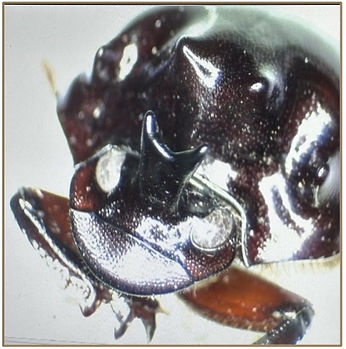
Onthophagus dicranocerus
We compared five habitat types: an abandoned pasture, three recovering rainforest sites (natural regrowth; abandoned orchard; ecological planting), and an intact, mature rainforest. Given our three recovering rainforest sites were formerly abandoned pastures, our current abandoned pasture acted as a baseline for recovery, whilst the mature forest acted as the target state. The natural regrowth site has been left unmanaged since 1978, recovering without human intervention; while the ecological planting site was actively restored by tree planting in 1993; and the old orchard site was originally planted with fruit trees (particularly lychee, mango and black sapote) but was abandoned in the 1980s, with natural regrowth beginning in the mid 2000’s.
Dung beetles were collected in the abandoned pasture, old orchard and mature forest plots in 2016 by Dr. Amanda Freeman, the previous centre director. We replicated the same methodology in order to measure changes in dung beetle community composition in each site over ten years and gain insight into the progress of the restoration strategies.
Dung beetles are commonly used in research as bioindicators to assess the condition of an ecosystem because they are ecologically sensitive and perform many important ecosystem functions. By breaking down, burying and laying their eggs in animal dung, they help to recycle nutrients, improve soil structure, disperse seeds and reduce parasites that inhabit dung. Dung beetles can be sorted into functional groups based on factors such as their body size and method of dung utilization. In Australia, native dung beetles are classified as either paracoprids (tunnellers) or telecoprids (rollers). Paracoprids tunnel directly under a pile of dung and bury pieces of dung to be eaten by their larva. Meanwhile, to avoid competition, telecoprids roll balls of dung away from their original sites and bury them in a separate location before laying their eggs in them. Distinguishing these functional groups is essential, as they perform different ecosystem services. For example, tunnellers help recycle nutrients at the site where the dung was laid, whereas rollers are especially effective seed dispersers, rolling dung (and any seeds contained within) away from its original location. For this reason, both functional and species diversity of dung beetles can act as a metric for ecosystem health, being used to assess restoration success.
Using pitfall traps, half baited with wallaby dung and half with rotting mushrooms, we collected 898 individual dung beetles representing at least 15 species. We identified the species and functional groups of these beetles to compare the species and functional diversity of the sites. Then, we were able to compare the dung beetles that we captured with those collected in 2016 to assess how these metrics have changed in each habitat type over the last ten years.

Figure 1. Mean ±SE dung beetle richness, evenness, Shannon’s Diversity Index (species diversity), and abundance (a-d) of traps by site. Unlike letters indicate statistically significant differences (p < 0.05). The pasture plot was excluded from the evenness calculation in (b) due to Pielou’s Index requiring abundances > 0.
Encouragingly, the dung beetle communities that we observed in our recovering growth types were, overall, much more similar to the mature forest than that of the pasture. Dung beetles were barely present in the pasture, with only 2 individuals caught during the entire sampling period. In contrast, our recovering forest sites had generally comparable species richness, evenness and diversity to the mature forest, with noticeably higher overall abundance (Figure 1). From a restoration perspective, these results are incredibly promising; all of our recovering sites were showing indications of recovery in the community structure and diversity of dung beetle species, and, by proxy, the overall rainforest community. However, with dung beetles highly dependent on the prevalence of mammal dung, the greater beetle abundance in these recovering forest systems could indicate the presence of generalist mammal species that are able to thrive in semi-disturbed, but not intact, forest (and contribute more dung).
This trend is also present temporally when comparing the 2016 and 2026 collection data. Dung beetle abundance more than tripled in the old orchard over the last decade, while abundance in the mature forest and pasture remained relatively static (Figure 2).

Figure 2. Mean ±SE dung beetle abundance of traps by site for 2016 and 2026 collections. Significant pairwise differences between 2016 and 2026 (p < 0.05, p < 0.01, and p < 0.001) are indicated by *, **, and ***, respectively.
Moreover, breaking down our observed species into functional guilds, we still observe stark differences in the communities of the recovering and mature forest sites. All of our recovering forest sites had about twice to three times as many tunnellers as rollers, while our mature forest had nearly equal numbers of rollers and tunnellers, indicating differences in the functional structures of these two types of communities (Figure 3a). It is also worth noting that both of the individuals caught in the pasture were tunnelling species, indicating increasingly equal functional guild abundance with progressive recovery. This pattern is also observed in 2016, with even seven times as many tunnellers as rollers collected in the old orchard plot (Figure 3b). Greater equality between functional groups in the 2026 old orchard collection likely indicates further forest recovery over the last decade.
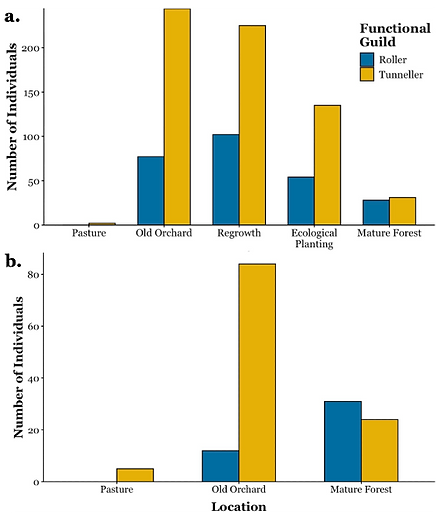
While our recovering forest dung beetle communities weren’t identical to our mature forest community, they demonstrated much greater similarity to intact forest than the pasture – the starting state of the recovering forest sites. It is worth noting, however, that each of these recovering ecosystems are occurring on different time scales, with different years of abandonment/restoration. Regardless, our study does suggest promising effectiveness in the ability of both intentional ecological restoration and unassisted regrowth methods in driving the recovery of rainforest communities

PLANT PROFILE - Candlenut (Aleurites rockinghamensis)
Dinah Hansman
Aleurites rockinghamensis, commonly known as candlenut, is one of the fastest-growing pioneer species used by TREAT for revegetation. It lives fast and dies young, contributing to rapid canopy closure and large volumes of forest litter, helping to exclude weeds and kickstart the rainforest ecosystem. Like most fast-growing trees, they have soft wood. They grow up to 30 m, with straight trunks (Figure 1). Then they fall over. Great for restoration planting but not a good species to select for an urban setting or planting close to buildings or other infrastructure.

Figure 1: A. rockinghamensis in the ground for 6 months
A. rockinghamensis was originally classified as a variety of Aleurites moluccanus. However, it is distinguished by its distribution, slightly larger flowers, and 3-4 locular fruit (see Forster, 1996). Both species have oily seeds which can be strung together and set alight to create a candle, hence ‘candlenut’.
Aleurites belongs to the family Euphorbiaceae. In the Coopers’ book many genera are included under Euphorbiaceae that are now separated out into other families such as Phyllanthaceae, but Aleurites remains in Euphorbiaceae. Rainforest Euphorbiaceae don’t have a definitive suite of ‘spotting characters’ (unique, highly distinct features used to quickly identify a plant or group of plants), nor the milky latex characteristic of Euphorbiaceae elsewhere. However, glands at the base of the leaf are common, and A. rockinghamensis has these. (Figure 2).
Flowers in the Family Euphorbiaceae typically have a three-lobed superior ovary, with one ovule per locule, that matures into a capsule fruit. (A capsule is dry, dehiscent fruit that splits open at maturity to release multiple seeds). A. rockinghamensis has flowers that are only male or only female. They are about 10 mm diameter and massed in panicles at the end of branches or in leaf axils (Figure 3).

Figure 2: Glands at base of leaf
A. rockinghamensis leaves are distinct, being large (up to 400 mm long and 300 mm across) with four lateral veins radiating from the point of attachment with the petiole (see Figure 2). New growth is covered in silvery and rusty stellate hairs, which persist along the veins on the upper surface of mature leaves. (See Figure 4 for an illustration of stellate hairs.)

Figure 3: A. rockinghamensis flowers
At times of the year when there is a growth flush (usually the end of the wet season), leaves shifting on their long petioles shimmer silver in the sunlight. The white flowers are produced at the same time as the new leaves, adding to the effect.
TREAT has harvested fruit in every month, but most commonly in March. They are collected from under large trees, where the rat-eaten remains of the hard spherical seed coat can be seen. (So, wear gloves when handling fruit.) Fruit are green, hard, about 70 mm diameter and usually three- or four-lobed. If not all of the ovules develop into seeds, then the fruit can be reduced to one or two lobes. There is one seed per lobe, and seeds are up to 25 mm across (Figure 5).
Seeds are sown in trays with seed placed on a bed of quincan gravel (scoria) and with most of the seed exposed. Seeds tends not to germinate until the weather is hot and humid. The rainforest key gives 66 days as the time to germinate, but at the TREAT nursery seeds take longer. (March collection to October or November germination is going to be 150 to 200 days). Germination, when it occurs, is very rapid, with seedlings ready to pot on in a week or two (Figure 6). It may be necessary to pot on seeds as they germinate, because seedlings grow so fast. Seedings will be ready to plant in the coming wet season.
Chionanthus ramiflorus seed with quincan gravel

Figure 4: Stellate hairs

Figure 5: A. rockinghamensis fruit and seed
TREAT has collected A. rockinghamensis from Regional Ecosystems 7.8.2, 7.8.3 and 7.8.4. It occurs from Cooktown to Paluma and is also in PNG. It has an altitudinal range from near sea level to 1000 m, often grows in disturbed rain forest but is also found in well-developed rain forest.
The related species, A. moluccanus occurs in the Pacific, Malesia and Asia as well as Cape York Peninsula to the Winsor Tableland in Queensland. It is more a lowland species. In Asia and the Pacific, cooked seeds of A.moluccanus are eaten. Don’t eat A. rockinghamensis seeds. Although they taste quite pleasant, they can produce severe vomiting and diarrhoea. Although A. moluccanus does occur in Queensland, the two species are very similar (see Forster. 1996). If you find a recipe that uses candlenuts, buy them from a supermarket or use macadamia nuts instead.
Forster, P.I. (1996) Taxonomic revision of Aleurites J.R. Forst. & G.Forst. (Euphorbiaceae) in Australia and New Guinea Muelleria 9: 5-13.
Available at https://www.biodiversitylibrary.org/item/209435

Figure 6: Germinating Aleurites
BIOCONTROL - John Clarkson
Biocontrol of weeds has come up recently on Friday mornings. The first was sparked by a report that blister leaf rust (Puccinia lantanae) had been approved for release for the control of lantana (Lantana camara). Then there was mention of biocontrol of cat’s claw creeper (Macfadyena unguis-cati). Both are Weeds of National Significance (WONS).
Biocontrol of lantana in Australia is not new. Four agents were introduced by the Queensland Department of Agriculture and Stock in 1914 and a total of 31 agents have been released (30 insects and 1 rust). Thirteen of these have failed to establish and three potential agents were introduced but not released.
Falconia intermedia, a leaf-sucking bug introduced in 2000 for the control of lantana, has become established on the Atherton Tableland. It has the greatest impact from late summer to autumn.
Biocontrol of cat’s claw was initiated in Australia in 2001. Six agents have been imported but only three approved for release.
All targets of weed biocontrol must be endorsed by the Environment and Invasives Committee (EIC) and a national standard is in place for the assessment and introduction of agents into Australia under the Biosecurity Act 2015 and the Environment Protection and Biodiversity Conservation Act 1999. Candidate biocontrol agents are only approved for field release if rigorous risk assessment demonstrates them to be of negligible risk to native and other valuable non-target plant species.

Falconia intermedia
Biocontrol is seldom a silver bullet. It won’t eradicate weeds. But it can effectively complement integrated weed management approaches.

Homolanthus novoguineensis (Bleeding Heart)
INDUSTRY INFLUENCE OVER THE REGULATION AND USE OF GLYPHOSATE - Jeremy Tager
In late 2025, the seminal paper declaring glyphosate safe for humans was retracted, because the peer reviewed paper was ghost written by Monsanto, was based solely on unpublished studies conducted by Monsanto and failed to include analysis of any of the many other long term studies that were available at the time.
The retraction raises two questions – is glyphosate safe and can the regulator, the Australian Pesticide and Veterinary Medicines Authority (APVMA) assessment of glyphosate and agricultural chemicals generally, be trusted? My view is that the answer to both is no.
The APVMA is Compromised
In 2015 the International Agency for Research into Cancer declared glyphosate a 'probable carcinogen' – putting it on the same list as DDT (Known and Probable Human Carcinogens | American Cancer Society ). The APVMA, however, refused to formally review its approval of the herbicide, unlike many regulators around the world.
This came as no surprise as the APVMA is 95% funded by industry.
Industry funding is a clear red flag for regulatory capture – regulators acting in the best interests not of the public but industry. In fact, industry funded studies have been shown in numerous independent studies to be unreliable and far more likely to favour the desired industry outcome than independent studies. In a pretty standard example, a 2007 study of nutritional drinks, ‘found that 0% of the studies with any industry funding came to unfavorable conclusions compared with 37% of the studies with no industry funding.’
The APVMA however, almost always relies solely on the data provided by industry. It does not seek independent peer review of industry studies that will form the basis of approvals and does not require data gaps to be filled.
Many of the tests conducted for purposes of seeking APVMA approval are now conducted in India and China and are not subject to regulatory review except via the application for approval. Negative results rarely see the light of day. (see Science Mart, Philip Mirowski, 2011)
Essentially, the APVMA approves chemicals based on an absence of evidence of harm not evidence that a chemical is safe. They are radically different standards.
The APVMA standard does not conform to the precautionary principle, which Australia claims to support.
The Precautionary Principle
The Precautionary Principle holds that in the absence of clear data showing a product is safe, caution should prevail. This may involve regulatory intervention, requests for additional data, rejection of an application for use or withdrawal of a product from the market. This is not the way the APVMA operates.
The APVMA does not comply with the Precautionary Principle, like many Australian regulatory agencies, because it is “at odds with the principle of minimum necessary regulation” (Food Standards Australia New Zealand, 2007). It's also at odds with the regulatory requirement that the APVMA consider 'trade impacts' in its decisions.
Is Glyphosate safe?
A peer reviewed study released in June 2025, (Carcinogenic effects of long-term exposure from prenatal life to glyphosate and glyphosate-based herbicides in Sprague–Dawley rats | Environmental Health | Springer Nature Link), part of an ongoing global glyphosate study and the most comprehensive study of glyphosate ever undertaken, has made deeply disturbing findings.
Long term exposure to glyphosate and glyphosate-based herbicides, even at very low doses considered safe in the EU, caused early onset leukemia in rats. It also revealed a significant increase in multiple other types of tumours including skin, liver, thyroid, nervous system, ovary, mammary gland, kidney, urinary, bladder, bone, endocrine, pancreas, uterus and spleen. The study noted that “while glyphosate alone is capable of causing numerous benign and malignant tumours, GBH (glyphosate based herbicides) coformulants can increase the carcinogenicity of glyphosate.”
The APVMA does not require assessment of glyphosate coformulations and continues to propagate the myth that the only active ingredient in these coformulations is glyphosate.
Despite the mounting evidence that glyphosate is not safe, the burden of proving harm is falling on the public, not the chemical industry. This is exactly what the precautionary principle is intended to prevent.
Unfortunately, bringing a case against the deep pockets of the chemical industry is incredibly expensive and incredibly difficult. Trying to prove that a single chemical has caused your cancer when there are over 250,000 chemicals in general commercial use is a daunting task.
Surely, though, with an epidemic of cancers in young people and an epidemic of disorders and diseases believed to be caused by environmental inputs such as chemicals and highly processed foods, it is time to change the way we assess and approve the poisons that we use and consume.

NURSERY NEWS - Peter Snodgrass
It was good to have a break after a very successful planting season was completed earlier this year. It was great to be stress-free while being away from the nursery, knowing that it was in good hands with Stephen. TREAT volunteers also never fail to impress with dedicated support ever-present in the nursery and in the field. Stephen’s knowledge, skillset and motivation has been great to have around this year helping us to catch up on a lot of tasks that were falling behind. Our database is consistently up to date and he has enabled us to catch up on some outstanding jobs around the grounds. A big shout out to Stephen for his efforts.
Catching-up has been further enabled with assistance from the VPG (Vocational Partnerships Group) crew. The most recent VPG crew, four young men, who were a little reserved at first though, soon relaxed after a couple of nursery sessions with TREAT. The lads helped us to complete the long-outstanding task of constructing the retaining wall beside the new shed, filling it with gravel, and tidying up the area. They were also busy putting together new shelving and painting shelves for indoors. We appreciate their input, and wish them all the very best for the future.
Stephen and I have also been busy behind the scenes delivering plants to Josephine Falls ranger base for planting at Eubenangee Swamp, recruitment and procurement.
The plans for the Nursery roof upgrade are all finalised, and we are hoping that we might see the insulated roof in place in the not-too-distant future. The project has taken some time to reach this point. As well, we have been doing our best to improve conditions in the nursery for both volunteers and staff.
There has been a considerable volunteer presence in the nursery over the past 12 months which means everything has been going very smoothly. All aspects of plant production have been fabulous and the plants are all looking great. Another huge thanks to everyone. Here’s hoping that Spring arrives with plenty of inspirational sunshine to encourage the finishing growth that we need for the trees to be at their best for next year’s planting season.
We have also reached the end of another financial year, and this means putting together the annual nursery report for the TREAT AGM that is only just around the corner. We are looking forward to seeing the final results for production and volunteer hours in both the nursery and the field.
We look forward to the AGM, and also to seeing you all through the nursery at some stage through the course of the year.
OTHER NEWS - Barb Lanskey
Revegetation projects for next wet season
Recently the TREAT committee has been visiting properties which are potential sites for either community or individual plantings next wet season.
It is a privilege to visit these places and talk to the owners about their plans for either expanding current habitat or beginning new areas.
As trees for planting come from the Lake Eacham nursery (as part of TREAT’s allocation of trees for the year), QPWS (Peter and Stephen) come along as well. Peter’s experience is invaluable and Stephen’s botanical knowledge a bonus.
Sometimes the area is big enough to warrant a community planting, but if the owner wants to plant the trees and is new to planting, the advice is generally to plant 300 trees as a start, and build on that with 300 trees the next year and the following years. It’s amazing how quickly the years go by and the area becomes established - with proper maintenance.
TREAT’s loan equipment
TREAT has various equipment which may be loaned to members to help with site preparation, planting and maintenance. QPWS recently made a small shed at the nursery available to TREAT for storing some of this equipment. Following some repairs to the shed, smaller tools such as poppers, are now at the nursery for collection and returning on Fridays.
Funding Opportunity
The following was received from Terrain: Grant Funding Opportunity for Threat Mitigation Projects
Funding is available through Terrain’s Green Connections project for landholders or groups to manage threats to native vegetation on private land in the Wet Tropics region. Eligible projects include management of weeds or pests, where it will help improve the condition of remnant or regrowth native vegetation. Projects in strategic locations, such as adjoining protected areas or providing important connectivity across the landscape will be prioritised. Nature Refuge landholders and Traditional Owner organisations are encouraged to apply. To register your interest or for further information, please email bronwyn.robertson@terrain.org.au.
The funding is provided as part of the Queensland Government’s Natural Resource Management Expansion Program.

FRUIT COLLECTION DIARY April to June 2026
Species | Common Name | Regional Ecosystem | Collection Date |
|---|---|---|---|
Galbulimima baccata | Magnolia | 7.8.4 | 26/05/26 |
Gillbeea adenopetala | Pink alder | 7.8.4 | 23/04/26 |
Halfordia kendack | Kerosenewood | 7.8.4 | 02/06/26 |
Homalanthus novoguineensis# | Bleeding heart | 7.8.2, 7.8.4 | 21/04/26, 07/05/26 |
Lomatia milnerae# | Lomatia silky oak | 7.8.4 | 07/05/26 |
Mackinlaya macrosciadea | Blue umbrella | 7.8.3 | 13/05/26 |
Melaleuca viminalis | Weeping bottlebrush | 7.12.29 | 13/05/26 |
Melicope bonwickii# | Yellow corkwood | 7.8.2, 7.8.3 | 05/05/26, 27/05/26 |
Melicope elleryana# | Corkwood | 7.8.2, 7.8.3, 7.8.4 | 13/04/26, 13/04/26, 02/06/26 |
Melicope vitiflora | Northern evodia | 7.8.2 | 29/05/26 |
Melicope xanthoxyloides | Yellow evodia | 7.8.2 | 07/05/26 |
Mischocarpus lachnocarpus | Woolly pear fruit | 7.8.2 | 13/04/26 |
Species and Common names taken from the Queensland Herbarium Census 2024