
TREAT News
COOL SEASON APRIL TO JUNE 2026
IN THIS ISSUE (Items are included in TREAT News for their interest to members and do not necessarily express TREAT's views)
The Northern Yellow-Bellied Glider Project
Plant Profile - Chionanthus ramiflorus
HELP WANTED AT DISPLAY CENTRE
As part of the Memorandum of Understanding between TREAT and QPWS, TREAT agreed to staff the Display Centre on Mondays, Wednesdays and Fridays from 9 am till 1pm.
Currently, Maryann organises a pool of volunteers to do this job on Mondays and Wednesdays, and on Fridays after midday till 1pm, as TREAT’s working bee volunteers are at the nursery till midday.
The pool of volunteers needs more people. If you can join it, please let Maryann or any of the TREAT committee know, or email info@treat.net.au. Volunteers usually do a 2 hour stint on a regular basis once a month, on a day and at a time that suits them. Some offer to do the full 4 hours.
The job is not onerous. New volunteers are shown what is required. Sometimes no visitors come to the Centre, but at other times a lot of tourists and locals come. If you like to interact with other people, you may hope for visitors, but if you’re a bookworm or engrossed in craft, you may hope nobody comes.
Please help if you can, even though it may not be on a regular basis if you have personal commitments.

2026 PLANTING SEASON - Barb Lanskey
At community plantings this wet season, volunteers planted over 21,000 trees. There were 10 community plantings scheduled. One was cancelled on account of boggy access conditions and another was postponed but completed over 2 weekdays. All the plantings should be doing well with the prevailing showery conditions.
Maalan Rd - 2500 trees - Jan 24th
This was an interesting site to visit and see where South Endeavour Trust are currently revegetating. (See Tim Hughes’ article in Apr-June 2025 TREAT News.) Conditions on the day were pleasant and the site well-prepared. The soil was damp for planting, with plenty of mulch in situ. There were about 60 people, including the team from NQLMS, and at the BBQ at the shed on the property, Melissa (who lives across the road) came and talked to us about the Spectacled Flying Fox camp at her place. She was happy the flying foxes would have more habitat available in future years.
Priors Ck - 2000 trees - Jan 31st
This was another interesting site and in the middle of Atherton. The weather had been wet, but was fine on the day. A lot of volunteers came to take part and see what the council were doing, so the BBQ (held in the shade of trees at the park near the Ck roundabout) catered for over 80 volunteers. Planting was mostly in the shade of existing trees along the creek and was finished before 9.30 am.
Wongabel - 1100 trees - Feb 7th
There had been rain and showers leading up to this planting, but on the day there was only drizzle and conditions were quite pleasant. The previous afternoon, volunteers and QPWS had taken off the frost guards left on a lot of the smaller trees for protection while spraying weeds. The soil was moist from some overnight rain, and the trees were watered after planting, using equipment from the QPWS Tinaroo Unit. The BBQ was set up in the shade near the start of the walking track and catered for about 60 volunteers. QPWS are hoping that by planting earlier this year, the trees may better survive a frost.
Maroobi Park NR - 2500 trees - Feb 14th
This planting had the School for International Training students helping with site preparation and planting. There had been no rain at the site for several days and the soil spoil had dried out. There was plenty of mulch in situ. At this planting, Alan started collecting pots in a large bag with a gadget, to save us carrying them with us, which worked well. The day was hot and humid and heavy rain was forecast - it arrived the next day. The planting finished about 10 am and the BBQ was held under the cover of the house entrance and catered for about 75 volunteers.
Freemans Forest NR - 2000 trees - Feb 21st
For this planting, volunteers were ferried by car to the southern side of Peterson Ck where Mark McCaffrey had prepared the site, with lots of dead grass mulch in situ. The soil spoil had dried out but good rain arrived during the next few days. The BBQ was held at the shed on Cutler Rd and catered for over 60 volunteers.
Strang Rd - 2500 trees - Feb 28th
This planting was cancelled for TREAT volunteers on account of boggy access conditions and a very wet BBQ site. The trees were planted by NQLMS and absorbed into the planting already being done there. NQLMS planted a total of 13,000 trees at the site.
Anderson Rd - 3000 trees - Mar 7th
On the previous afternoon, trees and most of the fertiliser had been put out in wet, showery conditions, but on the day of planting, it was overcast and pleasant, though we still needed to be aware of slippery ground. The last of the fertiliser was put out on planting day, and water crystals were also put out then. We had 100 small bales of hay for mulch. The fitter of the volunteers planted and mulched on the steeper slopes. Andy had set up irrigation and he’d cut up an un-wanted tree to use logs at various points to reduce water flow erosion. There were over 60 volunteers and the planting finished soon after 10 am. The BBQ was held at the northern patio of the house and we had a low concrete wall to sit on, as well as using the small folding stools.
Gourka Rd - 2500 trees - Mar 14th
This planting at Sue Careless’ property was wet, with light showers. There were fewer volunteers, about 40, and we were grateful to finish before 10.30 am and go to the BBQ back at the house, where it then stayed fine. Sue and Wayne were very appreciative again of the help from TREAT, and Mark McCaffrey’s preparation of the site.
Gourka Rd - 3000 trees - Mar 21st
During the week, Cyclone Narelle threatened the coast with plenty of rain, and the planting at Reinhold and Petra’s property was postponed. It was partly held on Tuesday, by which time the water in 1000 pre-dug holes had drained away. Another 800 holes were augered and planted. Conditions were cloudy and very comfortable. Fertiliser was added to the holes on the day. There were fewer than 20 of us but we chatted as we planted and the job was finished about 11.30 am. Much of the soil spoil had been washed back into the pre-dug holes but it was easy to dig and mix with the fertiliser. On Thursday, a further 800 holes were augered and planted by about 10 of us and we finished at 11am. The remaining 400 trees were to be planted by Reinhold and Petra another day.
Peluchetti Rd - 3000 trees - Mar 28th
It was fine and sunny for the last planting of the season and on flat ground. The soil had dried out and the trees needed watering after planting. Pots were left at trees until they were watered. Temporary hoses were used and some volunteers watered while others planted. Planting finished by 11 am and the BBQ in the shade of the shed was very welcome. Afterwards a group went back to complete the watering. Nearly 60 people signed on, from Cairns and Mareeba as well as the Tablelands.

THE NORTHERN YELLOW-BELLIED GLIDER PROJECT - John Winter
In its inception the Project focused on three populations within the Atherton to Ravenshoe area: (a) Mt Baldy Forest Reserve behind Atherton (b) Gilbey Forest off Byers Rd, Wondecla, in the Bluff State Forest and (c) Tumoulin Forest Reserve adjacent to Ravenshoe. It was aligned with the biennial census of gliders in the upper reaches of the Daintree River, the observations on Mt Windsor Tableland and the Nitchaga population in the Koombooloomba area.
The aims of the projects were to involve the general community in the conservation of the glider, of which one of the main aims was to document the glider’s occurrence within the study areas.
In an evocative paper entitled ‘Counting the books while the library burns: why conservation monitoring programs need a plan for action’ (Lindenmayer et al. 2013), it was emphasised that there was no point in establishing the detail of habitat and population numbers of a species unless measures were undertaken to enhance its conservation.
One such measure The Glider Project has taken is to ensure that the glider populations were in a secure tenure that protected their habitat. At the time of the inception of the Project, tenure of the glider’s habitat was:
-
Mt Windsor Tableland population – Mt Windsor National Park
-
Mt Carbine Tableland population (including the Daintree census area) – Daintree National Park, Mt Spurgeon National Park, Mt Lewis National Park
-
Mt Baldy population – Mt Baldy Forest Reserve
-
Gilbey population – State Forest with adjoining populations in freehold and Herbert Range National Park
-
Tumoulin population – Tumoulin Forest Reserve
-
Nitchaga population – Koombooloomba National Park.
Forest Reserve was a temporary tenure established by the Queensland Labor Government with the intention of converting them to National Parks. All such Forest Reserves had to revert to a permanent tenure by the end of 2025. The Bluff Forest Reserve of that time was reverted back to State Forest by subsequent governments.
State Forest would allow logging to recommence, an industry considered to be disadvantageous to the glider’s long-term conservation.
How has tenure improved for the conservation of the glider’s habitat?
Gilbey Forest is the location of Rupert Russell’s seminal study of the glider’s behaviour in the 1980s, within the Bluff State Forest (Russell 1984). During the time of his study the area was declared a Scientific Area SA44 ensuring management of the forest for the benefit of the gliders. However, when the State Forest was converted to Forest Reserve, the Scientific Area SA44 automatically no longer applied. Then, when the Forest Reserve was reinstated to State Forest, the Scientific Area did not automatically become incorporated. However, members of the Glider Project eventually managed to have SA44 reinstated within the Bluff State Forest in 2019, thus ensuring the forest was managed for the glider’s benefit.

Carol representing QPWS&P, John – TKMG, Meaghan – Qld Minister for the Environment, Liam – Wabubadda Aboriginal Corporation
Tumoulin Forest Reserve Over time, correspondence took place with the Queensland Government to have the area declared National Park. Eventually a joint submission by Wabubadda Aboriginal Corporation, representing the Jirrbal people, and the Tree Kangaroo & Mammal Group was made to the Queensland Government on 23 June 2022. The submission was for the area to become Conservation Park as this was considered to be the tenure most likely to succeed. However, in its wisdom the State Government agreed to change the tenure to the more protective National Park. It was declared National Park on 1 July 2022 in Cairns. In a meeting of Jirrbal people in Tumoulin Forest Reserve on 19 June 2022 organised by Terrain, not long before the submission, it was proposed that the area bore the name Mungurru Wabu meaning glider forest in the Dyirbal language. It is currently used as an unofficial name that needs to be ratified.
Mt Baldy Forest Reserve Because all Forest Reserves had to revert to a permanent tenure by the end of 2025, the Queensland Government has converted the Forest Reserve to a mixture of National Park and State Forest. While most of the Northern Yellow-bellied Glider sap trees, representing the glider’s distribution, are within the National Park, a cluster fall within the north-eastern corner of the State Forest. That section of the State Forest will need to be managed to protect the Northern Yellow-bellied Glider, an Endangered species.

Map: Pink areas = State Forest; pale yellow areas = National Park; circles = glider sap-trees.
Currently most of the glider’s habitat is in protected areas conducive to their conservation. However, some populations are in freehold land particularly within the Wondecla area. Many of the landholders are aware of the glider’s presence and take measure to protect the glider’s habitat within their properties.

PLANT PROFILE - CHIONANTHUS RAMIFLORUS - Dinah Hansman
The Native Olive Chionanthus ramiflorus is a useful revegetation species for northern Queensland. Common names are usually unhelpful but in this case C. ramiflorus is actually a member of the Olive family, Oleaceae. The fruit resembles an olive but is not, however, recommended for human consumption. You can recognise species in the Olive family by their whitish leafy twigs, usually with lots of pale lenticels, and the decussate leaf arrangement. This means that the leaves are in opposite pairs, with each pair at right angles to the next pair above or below. Ligustrum species (Privet) including the native privet Ligustrum australianum, and Olea paniculata are also in the Olive family and can be recognised by these spotting characteristics.


Decusatte leaf arrangement
C. ramiflorus is a useful species for revegetation because it is tolerant of drier conditions—occurring in rainforest, monsoon forest, dry rainforest and beach forest. In Australia its natural distribution is from Cape York Peninsula to near Gladstone with an altitudinal range of 0 to 600 m. It also occurs in Asia (southern China to south-east Asia), the Indian sub-continent (Nepal to Sri Lanka), Malesia, PNG and Solomon Islands. The genus is even more widely distributed, with 140 species mostly in the tropics and subtropics but extending to North America.
Many species with a wide distribution are resilient but this can also make them weeds. Brisbane City Council lists C. ramiflorus as a weed because it proliferates in bushland outside its original distribution.

Chionanthus ramiflorus fruit
C. ramiflorus is readily spread by birds large enough to swallow the 25 mm long and 15 mm diameter fruit. Dispersers include Cassowaries and Pied Imperial Pigeons and other pigeons.
Fruit resemble a wild olive, blue-black in colour with thin flesh covering a stony endocarp. This type of fruit is called a drupe. The fruit bears a superficial resemblance to Cryptocarya (laurel) fruit but Cryptocaryas do not have a stony endocarp. There is a single seed inside the stone. Olea paniculata fruit look similar but are shiny. There are three other Chionanthus species in north Queensland but they can be distinguished by their fruit.
On the Atherton Tablelands, C. ramiflorus has been collected from RE types 7.8.1, 7.8.3, 7.3.10, 7.8.2 and 7.8.4, with fruiting mostly occurring from August to October. Seed usually germinates relatively quickly and readily—35 days in the TREAT nursery and seedlings grow rapidly.

Chionanthus ramiflorus seed with quincan gravel
THE CINDER CONE MABI RESTORATION PROJECT -
Jane Leak, Nico McCarver and Sigrid Heise-Pavlov
Since 2022, the Centre for Rainforest Studies (CRS) has been working to restore Mabi forest on a cinder cone located between Wongabel State Forest and Curtain Fig National Park (Figure 1).
Figure 1. Locations of the restoration cinder cone and nearby Mabi forest fragments (in pink). Figure was created using Google Earth.

This project has been an opportunity to test reforestation techniques on steep slopes of cinder cones while working on establishing wildlife corridors between Mabi fragments (see article from Hulseman et al. in the Dry Season 2024 TREAT newsletter). The goal is to create a Manual for Mabi Forest Restoration on Cinder Cones.
So far two plantings have been established, one in April 2024 and one in April 2025. Each planting included 32 stems of nine different species (Table 1), which were selected from existing Mabi species lists (Goosem and Tucker 2013, North Queensland Land Management Services, QPWS).
Table 1. Mabi species planted in the 2024 and in the 2025 plantings on the restoration cinder
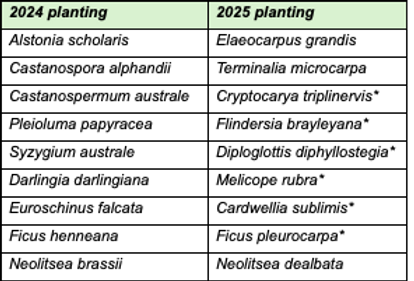
* Seedlings provided by Wandana Waters Nursery; all other seedlings provided by Lake Eacham QPWS Nursery.
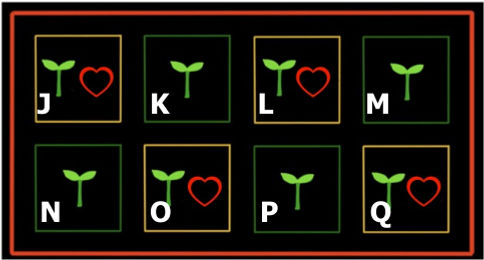
Apart from different Mabi species, the two plantings differed with respect to companion plants as we wanted to test their effect on seedling growth. Banana plants were used as companion plants in the 2024 planting and they were interspersed with the planted seedlings. In the 2025 planting we used Bleeding Heart seedlings (Homalanthus novoguineensis) as companion plants and they were planted right next to each seedling. Companion plants were planted in four of the eight 11m x 11m (treatment plots) while no companion plants were planted in the four control plots (Figures 2 and 3).
Figure 2. Plot design of the 2024 planting. A, C, F and H are treatment plots with bananas. B, D, E and G are control plots.

Figure 3. Plot design of the 2025 planting. J, L, O and Q are treatment plots containing Homalanthus novoguineensis. K, M, N and P are control plots.
In November 2025 we went out to assess the success of the 18 different Mabi species in these two plantings and to see whether companion plants had made a difference in seedling growth and survival. We measured each seedling height from the base to the top of its stem and noted any dead seedlings.
We found that Euroschinus falcata grew the most in the 2024 planting while Melicope rubra grew the most in the 2025 planting. Syzygium australe had the highest survival rate in the 2024 planting, and Cardwellia sublimis, Ficus pleurocarpa, and Terminalia microcarpa all tied for highest survival rate in the 2025 planting. Though our 2025 planting was only 6 months old, we predict these species will be successful for replanting cinder cones in the long-term (Tables 2 and 3).
Table 2. Survival rate of species in the 2024 planting. (Data from Apr-2024 to Nov-2024 from Jaros and Rardin, 2024).
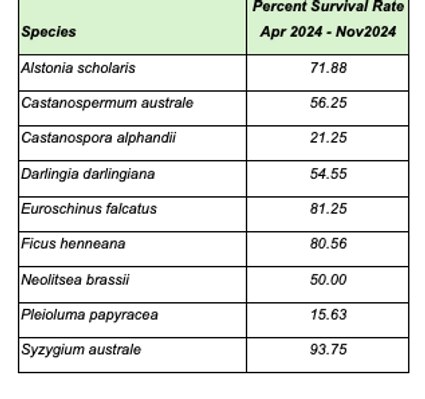
Table 3. Survival rate of species in the 2025 planting.

Seedling losses were high in the 2024 plantings which we attributed to a lack of irrigation of seedlings during their first dry season in 2024. The western slope of the steep cinder cone can experience very hot conditions. This, in combination with high runoff due to the steepness, may have caused seedling mortality. To avoid this happening to the 2025 seedlings, a drip-tip irrigation system was installed in the 2025 planting in October 2025. Money came from a TRC grant for which we are thankful. The system was installed with the help of students of the Dry 2025 semester, under instructions from Pieter Moerman whose experiences in irrigation systems were most valued.
With respect to companion plants, we found that only a few bananas survived (only 18%) and the plots with bananas seemed to have higher mortality and lower growth rates of the seedlings than the plots without bananas. This suggests that bananas are not an effective companion plant for cinder cone restoration, likely competing with Mabi seedlings instead of supporting them. Seedlings planted with Homalanthus novoguineensis as companion plants seem to do a bit better than seedlings without this companion plant in the 2025 planting. However, it is too early to tell if they will benefit the growth of seedlings as this planting was only six months old at the time of our survey.
In order to establish a list of Mabi species that are most suitable for replanting a Mabi forest under such harsh conditions as a western cinder cone slope, we also surveyed existing Mabi successional forest stages on three other cinder cones in the Atherton Tablelands. All cinder cones were cleared at some stage in the past and most of them were used as cattle pasture (as was the one we are trying to revegetate - it was cleared in the 1980s). However, on some cinder cones pasture use ceased at various times and since then Mabi successional stages became established. We visited four sites on the western slopes of three cinder cones in close proximity to our restoration cinder cone (Figure 4). We also used two vegetation surveys that were conducted in 2006 at the upper western slope of Mt Quincan.

Figure 4. Map depicting cinder cone survey locations (yellow circles). Sites 1 - 4 are locations we surveyed. 1-2006 and 2-2006 are the locations on Mount Quincan from the 2006 surveys. Figure was created using Google Earth.
At each site, we collected some pioneer species of interest, but focused on larger trees within areas which had dark, well-established canopies. Sampling was not easy, given the occasionally dense thickets of lantana, tobacco and Guinea Grass that we had to cross to get to some of the successional Mabi stages on these cinder cones. Samples were collected using loppers and a tree cutter and identified with the help of botanist Dr David Tng, Centre Director at CRS, and Lucid Central’s Australian Tropical Rainforest Plant key (2025).
We collected and identified 38 Mabi rainforest species at the four survey sites. Pooling our surveys and the 2006 surveys, Acronychia acidula, Anthocarapa nitidula, Castanospora alphandii, Callicarpa pedunculata and Clausena brevistyla were recorded in three of the six sites while Alstonia scholaris, Dysoxylum mollissimum, Dysoxylum parasiticum, Melia azedarach, Wilkiea longipes and Zanthoxylum ovalifolium were recorded at four of the six sites. Codiaeum variegatum and Ficus copiosa were found at five of the six sites. Neolitsea dealbata and Phaleria octandra were recorded at all six sites. Alstonia scholaris, Castanospermum australe, Melicope rubra, and Neolitsea dealbata are species which were planted on our cinder cone and also found on other cones.
Apart from species we identified as most successful from the 2024 and 2025 plantings (Euroschinus falcata, Syzygium australe, Cardwellia sublimis, Ficus pleurocarpa, and Terminalia microcarpa), we also recommend to use for future restoration plantings on the restoration cinder cone the following species: Codiaeum variegatum, Dysoxylum mollissimum, Dysoxylum parasiticum, Melia azedarach, Wilkiea longipes, Zanthoxylum ovalifolium, Ficus copiosa and Phaleria octandra.
In conclusion, our study gathered helpful insight for future Mabi plantings. CRS will continue to test techniques and improve upon planting lists until the cinder cone is returned to rainforest once more and a manual for Mabi Forest Restoration on Cinder Cones is completed.
Update on the effect of Bleeding Heart (Homalanthus novoguineensis) as a companion plant:
More measurements of seedlings were taken in February by a new cohort of students who attended our Wet 2026 semester. Measurements were taken on seedling survival and growth in plots with and without Homalanthus novoguineensis. Homalanthus novoguineensis plants grew rapidly and appear now as small trees (some about 1.80m tall). They found that most seedlings did not show a significant difference in growth rate when planted next to a Homalanthus novoguineensis plant versus planted alone. However, Ficus pleurocarpa did grow taller when planted with a Homalanthus novoguineensis seedling than when planted alone.
Surprisingly, the picture looked quite different in May 2026. Precise measurements have not been taken yet, but during weed control activities it was very obvious that seedlings in control plots (without Homalanthus novoguineensis) were much taller than those in treatment plots (with Bleeding Heart). It was also noticed that seedlings that ‘lost’ their companion plant (Homalanthus novoguineensis died) grew quite well over the last wet months. This observation suggests that Homalanthus novoguineensis plants may not support seedling growth, but rather suppress it (via competition?). Precise measurements will be carried out soon … so: watch this space!

Homolanthus novoguineensis (Bleeding Heart)
HERBICIDE RESISTANCE - John Clarkson
After my short article on glyphosate appeared in the last Newsletter, several members suggested that, as many weeds were becoming resistant to glyphosate, its usefulness was waning. This is only partly true. While glyphosate resistance has been observed in many weeds, it is not the only herbicide where this has been recorded. In this article I will attempt to explain how resistance to herbicides develops and what can be done to prevent it.
Herbicides kill weeds in many ways. How they do so is referred to as their mode of action. There are currently 31 defined groups. The mode of action will be shown on the drum or package (Fig 1). Until 2021, Australia used a letter-based mode of action (A to R plus Z) but have recently transitioned to an internationally accepted numerical system. For example, prior to 2021, glyphosate was listed as Group M. It is now referred to Group 9.
Herbicide resistance is tracked internationally by the Global Herbicide Resistance Action Committee (HRAC) (https://hracglobal.com/). Their records show that, around the world, about 273 weed species have been confirmed to be resistant to at least one herbicide mode of action. Understandably, most of the focus has been on weeds of cropping situations where crops are inspected frequently and weeds can significantly limit crop production. Herbicide resistance can be easily overlooked in other situations.
There is a popular belief that herbicide resistance is caused by applying herbicides at a reduced rate that only 'half kills' the weed meaning it comes back stronger (resistant) to the herbicide. This is not how resistance develops.
In any population there is genetic variation in many traits. Think of humans. There are 4 blood types, A, B, AB and O, controlled by a single gene. In Australia 40% of people have Type O blood and only 1% Type AB. Eye colour is more complex and controlled by multiple genes. Plants are the same. Their susceptibility to herbicides is controlled by specific genes. In any population there will be extremely rare individuals that are genetically resistant to herbicides of a particular mode of action. When these herbicides are applied, the susceptible plants die and the resistant individuals survive and pass on the resistant trait in their seeds. Constant use of the same herbicide group will result in individuals with the resistant gene becoming more and more common. In time only resistant plants will remain.
In cropping situations, the risk of resistance developing can be reduced by:
-
using mechanical weed control methods, such as cultivation, to control weeds,
-
rotating herbicides—do not make more than two consecutive applications of herbicides with the same mode of action in the same field,
-
using tank mixtures of herbicides with differing effective modes of action,
-
crop rotation,
-
scouting fields after herbicide application and destroying any weeds that haven’t been killed,
-
using herbicides with short soil residual times—herbicides with long soil residual times generally favour herbicide resistance, and
-
cleaning equipment before moving to a different field to prevent the spread of resistant biotypes and save work in fields with suspected herbicide resistance for last.

The mode of action must be shown on all herbicide packages. Glyphosate is a Group 9 herbicide.
In revegetation projects, such as those TREAT is involved in, herbicide use is usually restricted to one or two applications when preparing a site and one or two applications in the years after planting. Canopy closure then usually supresses further weed growth and any weeds that remain, including any resistant weeds, are shaded out. Any herbicide resistance that has developed can easily go unnoticed. However, it is important to remember weeds can be spread in many ways. Can you be sure that the weeds present in new sites are not resistant biotypes spread from other areas? It pays to be observant.
NURSERY NEWS - Stephen McKenna
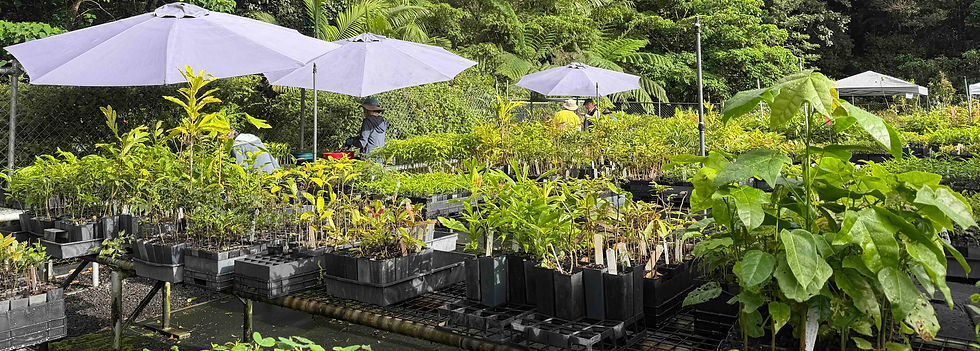
The first quarter of 2026 has been a productive time at the nursery. Trees have been prepared and dispatched for a busy planting season. This mammoth effort is only possible with the support and passion of the TREAT volunteers – a big shout out and thanks for all your efforts! We’ve been fortunate to have continuing assistance from School for Field Studies students and the team from Vocational Partnerships Group.
The Wongabel site infilled during February’s planting is looking great. We’ll be seeking assistance in May to put on frost guards to protect the plants during the coming cold weather.
We’re finally getting some decent-sized gaps on the outside benches. A few coastal batches of plants remain for planting at Eubenangee, Goldsborough and Wallaman Falls. The next season’s plants are being sown and potted in readiness. Carry-over stock is being sorted, sized and prepared for repotting.
Seed collection activity is now slowing. Fewer plants are fruiting as the weather cools. The fruit and seed processing efforts of volunteers has been fantastic. Not all species are fun to work with, and we’ve had to keep sneaking out these pesky species for attention over multiple Fridays.
The propagation room is still over capacity with trays on trolleys and a big potting up push is underway to fill the gaps in the benches outside. The greenhouse has had several benches of wire mesh replaced, for a safer and stronger surface.
On a personal note, it’s been great to reconnect with the nursery after first working here last century. It’s been a bit of an adjustment trying to remember plant names and how to collect and propagate them. Quite a few things have changed since the ‘old days’. The operation is a lot more effective and efficient. It’s striking how many more volunteers are attending on Fridays. There’s still some of the old crew around, continuing for more than 30 years – an amazing effort!
Peter commenced some well-earned leave in early April when the planting season finished. We hope he’s had a fun and restorative break.

FRUIT COLLECTION DIARY January to March 2026
Species | Common Name | Regional Ecosystem | Collection Date |
|---|---|---|---|
Acronychia crassipetala | Crater aspen | 7.8.4 | 4/01/26 |
Aglaia australiensis | Brown ripples | 7.8.2 | 4/01/26 |
Aglaia sapindina | Boodyarra | 7.8.2, 7.8.3 | 7/01/26, 2/01/26 |
Alocasia brisbanensis | Cunjevoi | 7.8.2 | 29/01/26 |
Alphitonia petriei | Pink ash | 7.8.2 | 29/01/26 |
Alpinia arctiflora | Pleated ginger | 7.8.2 | 19/03/26 |
Alpinia caerulea | Common ginger | 7.8.2 | 18/03/26 |
Antidesma erostre | Currantwood | 7.8.3 | 19/01/26 |
Aphananthe philippinensis | Native holly | 7.8.3 | 15/01/26 |
Apodytes brachystylis | Buff alder | 7.8.2 | 15/01/26 |
Archirhodomyrtus beckleri | Rose myrtle | 7.8.2 | 13/02/26 |
Athertonia diversifolia | Atherton oak | 7.8.2 | 16/01/26 |
Species and Common names taken from the Queensland Herbarium Census 2024