
TREAT News
WET SEASON JANUARY TO MARCH 2026
IN THIS ISSUE (Items are included in TREAT News for their interest to members and do not necessarily express TREAT's views)
COMING EVENTS: SATURDAY MORNING COMMUNITY PLANTINGS 2026
24 Jan RN 252 Malaan Road, Beatrice Way (SET) 2500 trees
31 Jan Prior's Creek, Atherton (TRC) 2000 trees
7 Feb Kennedy Highway, Wongabel (QPWS) 1000 trees
14 Feb Maroobi Park NR, RN 109 Gadgarra Rd. Lake Eacham (SET) 2500 trees
21 Feb Freemans Forest NR, RN 2 Cutler Rd. Lake Eacham (SET) 2000 trees
28 Feb Strang Rd, East Evelyn (EFT) 2500 trees
7 Mar RN 49 Anderson Rd, Peeramon (Thieme/Monks) 3000 trees
14 Mar RN 128 Gourka Rd, Topaz (Careless 2500 trees
21 Mar RN 128 Gourka Rd, Topaz ( Muller/Buttner) 3000 trees
28 Mar RN 130 Peluchetti Rd, Atherton (Smith) 3000 trees
NR - Nature Refuge
SET - South Endeavour Trust
TRC - Tablelands Regional Council
EFT - Emerald Forest Trust
-
All plantings start at 8am. Please car-pool as much as possible.
-
Bring a hat, sunscreen and water, plus gloves and a trowel if you have them.
-
Look for the TREAT signs for directions when close to each planting.
-
TREAT will provide a barbecue after each planting.
-
To check for likely changes due to weather conditions, be on the email list for update information. To be on the email list, email info@treat.net.au
There are 10 community plantings scheduled for this wet season. Five of them are at places where community plantings have previously been held and five are at new locations.
Trees
Approximately 24,000 trees will be planted at this year’s community plantings, plus many more are planted privately. The main nurseries supplying trees for the Tablelands are the Lake Eacham nursery, the NQLMS (NQ Land Management Services) nurseries and the TRC nursery.
This year the Lake Eacham nursery has allocated to TREAT 11,000 trees for community plantings and it has an ongoing commitment to allocate 5,000 trees to SET. It also supplies trees for QPWS projects, plus trees to TREAT members for planting on their properties (up to 300 per member each year).
With new benefactors becoming interested in rainforest restoration, the supply of appropriate trees for the various ecosystems is an important issue as the present tree nurseries are stretched to meet the demand.
Funding for the plantings
SET & EFT - These Trusts seek funding from various sources.
TRC - The Federal Govt.’s ‘Reef Guardian Council Program’.
Thieme - Private, plus TREAT has applied for irrigation equipment from the Qld. Govt.’s ‘Grassroots Environment Grants’, to be used at this planting until the trees are established.
Careless - The Qld. Govt.’s ‘Grassroots Environment Grants’ funded last year’s planting and TREAT has applied for funding from them again this year.
Muller/Buttner - Private, plus Terrain’s ‘Green Connections Revegetation/Restoration Projects’ through an EOI (expression of interest) from TREAT, for chemicals used in site prep and maintenance, and contractor assistance by Mark McCaffrey.
Smith - Terrain’s ‘Green Connections Revegetation/Restoration Projects’ through an EOI from Barron Catchment Care, for site prep and maintenance.
Barbecues
TREAT organises a BBQ after each planting and has 2 teams who do this. This year the first team will be at the first group of plantings and the second team will be at the later plantings. They take the TREAT catering trailer to the planting site and if there is no under-cover area to use, they erect gazebos to work under and to provide cover for the planters after their morning’s work.
Maalan Rd - new site - Jan 24th
-
This is an area where planting is already being done by NQLMS. It is between forested areas of the Maalan National Park and Wooroonooan National Park.
-
The trees will come from NQLMS and site prep and maintenance is done by NQLMS.
-
From Millaa Millaa, take Beatrice Way (the Old Palmerston Highway) and look for the Maalan Rd sign on the left, about 3 kms after Pepina Falls. Follow Maalan Rd until a you see a house and shed close to the road on the RHS. This is the site and there is plenty of parking space. If you’re at Ravenshoe, take Beatrice Way and Maalan Rd is on the right with the house and shed on the LHS.
Prior’s Ck - new site - Jan 31st
-
This planting will be on the eastern side of Prior’s Ck at an area between Silo Central and Jack St.
-
TRC is creating an interpretive walk among the trees already there and this planting will be infill.
-
The trees will come from the TRC nursery and the associated pathway may have already begun. Holes will be dug by a contractor.
-
Meet near the Mens Shed (the former Railway Station) at the bottom of Jack St.
-
The BBQ will be held near the Prior’s Ck roundabout.
Wongabel - Feb 7th
-
Many trees were again lost to heavy frost last year, despite the use of frost guards, and this planting will be another infilling of the site. The frost guards used may be already removed or will be part of the work for this year’s planting.
-
Parking is at the walking track area on the opposite side of the road, and this is where the BBQ is held.
Maroobi Park NR - Feb 14th
-
This planting is on the property formerly owned by Don Crawford and now owned by SET - see Tim Hughes’ article this newsletter.
-
The trees will come from the Lake Eacham nursery, as part of TREAT’s allocation, and site prep is being done by Mark McCaffrey. SIT (School for International Training) students will be helping with hole digging, and will also assist at the planting.
-
Parking is on the property.
Freemans Forest NR - Feb 21st
-
This planting is revegetating an area above the existing planting on the south side of Peterson Ck.
-
The trees will come from NQLMS and site prep is being done by Mark McCaffrey, with funds from Terrain.
-
Parking is at Cutler Rd. The planting site entrance is off Lake Barrine Rd and planters can either walk to the site along the road or be ferried there by car.
-
The BBQ will be held at the shed on Cutler Rd.
Strang Rd - new site - Feb 28th
-
This site is opposite Mt Fisher and the planting is adjacent to the forested area of Tumoulin Forest Reserve.
-
Take the Kennedy highway heading towards the wind farm, past Sluice Ck Rd to Greenway Rd on the left.
-
There is an area for parking here near North Cedar Ck. The site is opposite Greenway Rd and 4WD vehicles can drive to the site, but otherwise it is a relatively short walk up the hill.
-
The trees will come from NQLMS and site prep and maintenance is done by NQLMS.
Anderson Rd - new site - Mar 7th
-
Andy Thieme and Leanne Monks have been planting trees on their property for several years and this year have prepared a significant area near Ross Ck and the Johnstone River.
-
The trees will come from the Lake Eacham nursery, as part of TREAT’s allocation, and site prep is being done by Andy.
-
Parking is on the property.
Gourka Rd (Careless) - Mar 14th
-
This planting adds to the planting done last year.
-
The trees will come from the Lake Eacham nursery, as part of TREAT’s allocation, and site prep and maintenance is being done by Mark McCaffrey.
Gourka Rd (Muller/Buttner) - Mar 21st
-
Reinhold and Petra’s property lies between Ault Rd and Gourka Rd and this planting is next to Gourka Rd between the 2022 and 2025 plantings there. The entrance is on Gourka Rd about 200m from the Careless property.
-
Trees will come from the owners’ home nursery, and 300 from TREAT. Site prep is being done by Reinhold, with help from Mark McCaffrey if needed.
-
Parking is on Gourka Rd, near Careless’ place, as the BBQ is being held there.
Peluchetti Rd - new site - Mar 28th
-
This is an area next to Nasser NR on the property, and was previously grazed by cattle. It will be added to the existing nature refuge area.
-
The trees will come from the Lake Eacham nursery, as part of TREAT’s allocation, and site prep and maintenance is being done by Nurture Restoration Solutions.
-
Parking is on the property.

Syzygium cryptophlebium fruit
DON CRAWFORD AND HIS LEGACY - Tim Hughes, South Endeavour Trust
TREAT member, Don Crawford, died in late 2024. He was a very particular and private man who had a great love for the Atherton Tablelands and rainforest. In the early 2000s Don was an active member of TREAT, attending most Friday mornings but always disappearing before morning tea. With several community plantings and TREAT's help, he planted about 12 hectares of rainforest from about 2005 onwards including a forestry plantation, on his 16ha property, Maroobi Park. The property sits between Lakes Eacham and Barrine and Don’s plantings significantly enhanced the earlier-planted Lakes Corridor. Most of these plantings, but not the forestry plantation, were protected under a Nature Refuge agreement. He grew many of the trees himself in a home nursery with the help of his wife Jill who was also an active member of TREAT. They held at least two TREAT Field Days to showcase the work they did and encouraged School for Field Studies and School for International Training students to undertake research into rainforest revegetation on the property.
Some years ago, Don approached me about the potential to create a legacy for rainforest restoration on the Tablelands. But Don being Don, he did not want anyone to know that we were even talking. And I was totally sworn to secrecy on the amount of money he was considering dedicating to rainforest conservation.
In the end, Don bequested to South Endeavour Trust his property at Maroobi Park and a substantial sum of money to be used to support rainforest conservation and restoration on the Tablelands. It is a fantastic legacy and we want to make the very most of Don’s generosity to make as large a difference as we can.
When Don and I talked about Maroobi Park, he acknowledged that the area that he had originally planted out as a forestry plantation should be added to the nature refuge and that we would probably want to plant out quite a bit of the sweeping grass area in front of the house. Both of these are now happening. DETSI (Dept. of Environment, Tourism, Science and Innovation) have been approached to extend the nature refuge area to cover the whole of the forested area on the property plus the plantings we will be doing this wet season. We will be putting in 2500 trees in February to reduce the area of grass by around 40%. What we want to do is preserve the views to the rim of Lake Barrine from the house, while planting out as big an area as possible in such a critical location between Lakes Barrine and Eacham.
As discussed with Don, we are also establishing a grant program, Crawford Rainforest Restoration Grants. This program will commit a total of up to $100,000 per annum to supporting rainforest restoration projects on the Tablelands. With regard to these grants we will consider any proposal brought to us that benefits rainforest restoration. This could include part or whole funding of planting projects. We will also be considering fencing projects that would protect significant rainforest plantings.
We are now taking applications from anyone interested. We do not have a formal process or application form, rather we want to hear from people in their own words about projects that they would like to undertake to benefit the restoration of rainforest on the Tablelands.
What we want to see are well conceived proposals that include:
-
What is proposed. For planting projects this must include maintenance until canopy closure is achieved.
-
How the project will provide a benefit beyond the actual area planted or protected e.g. corridor value or buffering a national park.
-
A full budget and project plan.
-
What the property owner or others will contribute.
-
What size of grant is being requested including amounts in relation to funding maintenance in future years.
We are happy to receive grant applications at any time.
Please contact Angela McCaffrey at angelamccffr@gmail.com
Image shows areas to be planted in 2026

We hope to be able to maintain this program for at least the next 10 to 15 years and that Don’s legacy will be a significant expansion of rainforest restoration on the Tablelands.

NATURE REFUGE/TREAT FIELD DAY AT GALAJI- John Clarkson
In mid-October, Topaz neighbours John and Marion Clarkson from Galaji Nature Refuge and Dan and Anusha Lazzari from Topaz Rainforest Nature Refuge co-hosted a field day for owners of nature refuges and members of TREAT. Over 90 people enjoyed a beautiful clear day in an area of the Tablelands renowned for its high rainfall. A guided walk in the morning gave participants the opportunity to compare and contrast the two properties. Galaji was largely cleared in the 1960s and is being revegetated whereas Dan and Anusha’s property was selectively logged. There was also an opportunity to watch an excavator-mounted mulcher clear a dense stand of giant bramble in preparation for a creek-side revegetation project scheduled for planting in January.
Over a BBQ lunch prepared by the TREAT catering team, participants could view a range of static displays highlighting aspects of the natural history of the area.
After lunch there was a short walk to inspect a tunnel associated with a water race built in the 1880s to carry water from the Johnstone River catchment to a gold mine in the Russell River catchment. In addition to its cultural significance, the tunnel is an important roosting and nursery site for several species of micro bats. Participants then inspected a long stem planting experiment established in April 2010.


Photos courtesy of Alison Fainiez
The day was also an opportunity for nature refuge owners to say thankyou and farewell to QPWS Nature Refuge Officer, Keith Smith, who was retiring at the end of the year. Keith was presented with an original artwork by local artist and nature refuge owner Helen Hume. It turned out that Keith and his wife Sue had a special connection to the waterhole in the painting.

Keith Smith with Helen Hume's artwork

Jaimie Russell's machine devouring weeds
GLYPHOSATE IN THE NEWS AGAIN - John Clarkson
The herbicide glyphosate is back in the news again. In early January, friend and fellow TREAT member, Will Cairns, drew my attention to an article published in The New York Times. The article discussed the retraction of a major paper published in 2000 in the journal Regulatory Toxicology and Pharmacology. The paper entitled Safety evaluation and risk assessment of the herbicide Roundup and its active ingredient, glyphosate, for humans (Regul. Toxicol. Pharm (2000) 31: 117-165) has been widely cited and has had a significant impact on regulatory decision-making regarding glyphosate and Roundup for decades. In announcing the retraction, the journal noted serious ethical concerns regarding the independence of the authors suggesting employees of Monsanto, the makers of Roundup, may have contributed to writing the article without proper acknowledgment as co-authors. The US Environmental Protection Agency still considers the herbicide to be safe but has been directed to re-examine glyphosate’s safety.
What does this mean for Australian users of the herbicide, in particular, TREAT members, many of whom rely on glyphosate for site preparation and post planting weed control? Here are some thoughts.
A Brief History
Glyphosate was first synthesized in 1950 by Swiss chemist Henry Martin, who worked for the Swiss company Cilag. However, it was not until the early 1970s that the United States’ company Monsanto developed and patented its use to kill weeds and brought it to market in 1974 under the brand name Roundup. Monsanto merged with Bayer in 2018 in a $63 billion USD acquisition. The brand name Monsanto was retired but Bayer continues to market Roundup under Bayer's name.
Not just Roundup
When Monsanto’s patent expired in 1991, other chemical companies began producing herbicides with glyphosate as the active agent in various concentrations and formulations. Currently, about 500 products registered for use in Australia contain glyphosate. These are manufactured and sold by many chemical companies. Despite this, when the herbicide is discussed in the media, invariably Roundup and its link to Monsanto is the only product mentioned.
The Regulator
The management and regulation of agricultural and veterinary chemical products in Australia is the responsibility of a statutory agent known as the Australian Pesticides and Veterinary Medicines Authority (APVMA). Before an agricultural chemical product can be sold in Australia, it must be assessed by APVMA scientists to determine whether the product meets the criteria in Australian law related to safety, efficacy, trade and labelling. The APVMA currently considers registered products containing glyphosate safe to use when the instructions on the label are followed. This is reviewed regularly as more data comes to hand. The Authority’s position can be found on its web site at https://www.apvma.gov.au/resources/frequently-searched-chemicals/glyphosate.
Not all products sold as Roundup contain glyphosate
At least 40 products registered for use in Australia have Roundup in their product name and about half of these do not contain glyphosate as one of the active agents. For example, a common product you will see marketed in supermarkets for home gardeners as Roundup contains nonanoic acid as the active agent.
Alternatives to Roundup
Glyphosate is a very effective herbicide. Its non-selective mode of action means it can be used to control most weeds – grasses, sedges and broadleaved plants. Although there are effective alternatives to glyphosate, each of these alternatives will be, in some way, less effective, less convenient, and/or more expensive. Contact herbicides will be less effective on larger weeds requiring multiple applications. Natural product alternatives will be significantly more expensive. Selective postemergence grass herbicides will be convenient but more expensive and do not control broadleaf weeds. Synthetic auxin herbicides are effective on perennial broadleaf weeds but may result in damage to desirable plants through either spray drift or root uptake. Mechanical controls, mulching or hand removal will be labour intensive and expensive and not suited to large areas of revegetation. Landscape weed control without glyphosate is certainly possible but will require more planning, careful consideration of alternative treatments, more frequent site visits, higher costs.
Have you read the label?
If you opt for chemical control, you are required to carefully read the label (or have it read to you). It is also recommended that you consult the Safety Data Sheet. This document will explain chemical hazards, safe handling, storage, emergency measures (like spills or fire), and protective equipment needed to ensure the chemical can be used safely.
Until the Australian regulator, the APVMA, recommends otherwise, Marion and I will continue to use glyphosate products on our property with appropriate PPE. This should not be seen as a recommendation for you to use or not use the herbicide. You must make that decision for yourself.
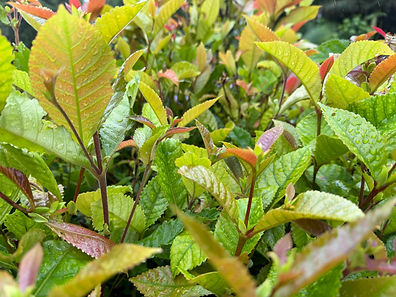
Pullea stutzeri in the TREAT nursery
PLANT PROFILE Pullea stutzeri FAMILY CUNONIACEAE - Dinah Hansman
In each newsletter’s ‘Plant Profile’ a different rainforest plant family is represented, and this time it’s the family Cunoniaceae. It includes 14 genera in Australia—you may be familiar with Ackama, Ceratophyllum, Davidsonia, Gillbeea and Schizomeria.
Plants in this family have opposite or whorled leaves. (Davidsonia is an exception, and until relatively recently was in its own family Davidsoniaceae. This is where you’ll find it in the Coopers’ book.) Leaves are usually compound—pinnate, trifoliate or palmate with large, leafy interpetiolar stipules. Leaves are often toothed and hairy. New foliage is typically colourful.
Pullea stutzeri showcases Family Cunoniaceae with its distinctive bronze or red new growth. Its common name is Hard Alder. Many unrelated rainforest species have the common name ‘Alder’ and none of these are related to the European Alder. Presumably their timber shares similar properties.
P. stutzeri is endemic to north-east Queensland, occurring from sea level to 1500 m. It grows along creeks and gullies and can often be seen growing alongside road edges (which are artificial gullies). Its bright new foliage makes it easy to spot.
TREAT has collected P. stutzeri seed from RE types 7.8.2 (in the wetter areas) and 7.8.4. Where there is a nearby seed source it is a common volunteer.
P. stutzeri has clusters of small white flowers, the long stamens creating the effect of soft white pom-poms. The fruits that follow are very small—only 3 mm diameter. Fruits look like dried flowers, with bits of the flower forming tiny wings.
TREAT has collected fruit on the Tablelands from January to September. The interval between flowering and fruiting is 8 weeks or less. Branchlets with clusters of fruit are harvested after making sure that the seeds are sufficiently mature. Seeds are less than one mm and you should be able to feel a hard grittiness if you roll the fruit in your fingers. The whole fruit is sown.
Seeds should germinate en masse within 25 days. Tiny seeds mean tiny germinating seedlings. The cotyledons are only 3 mm long. Tiny seeds don’t have many nutrient reserves, and seedlings may starve. In the TREAT nursery plants are given a ‘powerfeed’ with ‘Plant Starter’ and ‘Seasol’. It is possible to have plants grown from seed collected in one wet season ready for planting in the following wet season.
This is an attractive tree with decorative glossy, dark-green leaves and colourful new foliage. It is a useful, fast-growing and resilient pioneer for wetter, frost-free sites and has also been observed being eaten by tree kangaroos.


germinating Pullea
Leafy interpetiolar stipule
Tiny fruit

NURSERY NEWS - Peter Snodgrass
2025 was a very productive year with trees going out to many different areas throughout the Wet Tropics World Heritage Area - Goldsborough, Mission Beach, Eubenangee, QPWS development projects in the Daintree, and to sites all over the Tablelands in areas of high significance. With the support of TREAT volunteers, our final planting for the year was at the Forty Mile Scrub National Park in existing and new areas. Conditions were dry and fairly comfortable on planting day, but all the trees received a good watering-in and storms followed close behind. A huge thank you to those who travelled to assist on the day and special thanks to Rob Bogart for organising lunch for us on the day.
The planting schedule has been decided and it is set to be a very busy 2026 season. All this would not be possible of course if not for the tremendous effort once again by all volunteers in the nursery, week in and week out. This year’s stock is looking great as a result of those efforts. Further appreciation goes out to the visiting students from Holland, SIT (School for International Training) and SFS (School for Field Studies) for their eager contributions in the nursery.
In mid-October we welcomed Stephen McKenna as a full time temporary new member to the nursery team. Stephen has been a great addition to the team, bringing many high-level skills with him including his excellent botanical skills. At this stage, Stephen is with us until mid-March, but we certainly hope that he is able to continue in the role beyond that date, and continue with his valuable contributions to the workplace.
Hopefully everyone has been able to successfully prepare their sites for planting, and the rain hangs around for a while after all sites have been completed.

FRUIT COLLECTION DIARY October to December 2025
Species | Common Name | Regional Ecosystem | Collection Date |
|---|---|---|---|
Abrophyllum ornans | Native hydrandea | 7.8.4 | 24/10/25 |
Aglaia meridionalis | Rusty almond | 7.8.2 | 14/12/25 |
Anthocarapa nitidula | Incensewood | 7.8.3 | 16/10/25 |
Aphananthe philippinensis | Native holly | 7.8.3 | 15/12/25 |
Apodytes brachystylis | Buff alder | 7.8.2 | 19/11/25 |
Archidendron ramiflorum | (blank) | 7.8.3 | 8/12/25 |
Argyrodendron peralatum | Red tulip oak | 7.8.2, 7.8.3 | 13/11/25, 8/12/25 |
Athertonia diversifolia | Atherton oak | 7.8.2 | 1/10/25 |
Auranticarpa papyracea | Green paperbark | 7.8.2 | 19/11/25 |
Austrobaileya scandens | Austrobaileya | 7.8.2 | 19/11/25 |
Beilschmiedia bancroftii | Yellow walnut | 7.8.4, 7.8.2 | 23/10/25, 28/11/25, |
Beilschmiedia tooram | Coach walnut | 7.8.4 | 23/10/25 |
Species and Common names taken from 'Australian Tropical Rainforest Plants Edition 8' online key: