
TREAT News
STORM SEASON OCTOBER TO DECEMBER 2026
IN THIS ISSUE
(Items are included in TREAT News for their interest to members and do not necessarily express TREAT's views)
COMING EVENTS
Date Time Event Location
Saturday 14 October 2026 9:00 am Tree ID & Plant Propagation Workshop
TREAT Nursery Lake Eacham
Saturday 21 October 2026 8:30 am Planting Workshop
Freemans Forest NR Cutler Road Lake Eacham
These popular workshops have been a highlight for new members over many years and are being held again this year. They are free and open to non-TREAT members as well as members. However, it is necessary to register if you wish to attend, as numbers are limited—please ring Barbara Lanskey (ph. 4091 4468) or contact the nursery on 4095 3406.
Tree identification & seed propagation workshop
This workshop is held in two sessions with a tea/coffee break in between, and is scheduled to finish at 12.30pm. Dinah Hansman presents the tree ID session and brings along samples of various tree branches to look at leaf features. She talks about leaf arrangement, feel, smell etc. and explains features such as domatia, glands, oil dots etc. which participants can see by using TREAT's hand lenses. Notes with diagrams are handed out. Peter Snodgrass presents the seed propagation session. At this time of year he has an assortment of seeds collected, and he shows the best ways to sow, germinate and grow the different seed types. Peter also hands out notes.
Planting workshop
This workshop is held at Freemans Forest Nature Refuge where hole digging and planting are demonstrated. An information session is held first, to talk about what is involved in site preparation, planting and maintenance of a planting site, and Mark and Angela McCaffrey together with Peter Snodgrass share their extensive knowledge and experience of these activities. Notes are handed out. There is a tea/coffee break after the information session, then at a designated area, augers are used to dig holes and trees are planted, to give participants hands-on experience. The workshop usually finishes about midday. Freemans Forest NR is on Cutler Road off Lake Barrine Road.
Christmas/New Year break
TREAT will have a Christmas morning tea on Friday 18th December, with extra food such as fruit and cheese platters, supplied by TREAT thanks to donations during the year to Smoko. The QPWS staff from next door usually come over to enjoy the food and company with us. The nursery will be closed for the Christmas/New Year period and the first working bee for 2027 will be on Friday 8th January.
2026 AGM REPORT - Barb Lanskey
The 44th TREAT Annual General Meeting was held in the evening of 4th September at the Yungaburra Community Hall. About 45 people attended and there were 8 apologies noted. It was good to see Barry Thurling there again—he’s been coming to the AGMs since the first one.
We followed the usual meeting procedure and again used the back wall as the screen for presentations.
As Acting Ranger in Charge while Peter Snodgrass was on leave, Stephen McKenna presented the Nursery Report and showed the nursery’s Production and Distribution statistics for the financial year, speaking about them and thanking TREAT for all their volunteer labour.
Barbara Slaughter had copies available of the year’s financial statements which had been audited by Eacham Accounting. She spoke about various items for her Treasurer’s Report, noting the generosity of several donors and the grant monies for planting projects.
John Clarkson then presented his President’s Report which was received with acclamation. (See his report in this newsletter.) Following this, he showed slides of the unique partnership of TREAT and QPWS, which he’d presented at the recent Australasian Plant Conservation Conference in Port Douglas.
All committee positions were then declared vacant and the list shown of those positions filled, as displayed at the nursery for the preceding 2 weeks.. The Secretary position was still vacant, but no-one from the floor offered to fill it. Doug Burchill has been Secretary since 2003 and stepped down from the position this year. He remains on the committee—and can be a mentor for a new Secretary if needed. (Since the AGM, Belinda Bogart has offered to rejoin the committee and take on the Secretary position.)
The committee duly elected was:
-
President - John Clarkson
-
Vice-president - John Hardman
-
Secretary - vacant
-
Treasurer - Barbara Slaughter
-
Committee members - Doug Burchill, Simon Burchill, Irene Gorman, Stephen Graham, Barbara Lanskey, Dave Skelton.
John Clarkson then called a General Meeting at which no matters were raised and it was extremely short.
Our guest speaker for the evening was Dr. Nigel Tucker, who spoke about connectivity across the landscape and particularly showed the current results of monitoring for the Three Corridors Project which connects Lakes Barrine and Eacham to the Curtain Fig National Park. His slides, which were summaries of current results, were very interesting. Monitoring has been ongoing since the first planting at Donaghy’s corridor over 30 years ago. Nigel has already published 2 papers and is hoping to publish in the near future, another paper based around his talk. The 2 papers published are: Soil seed bank study, http://doi.org/10.1111/rec.70159 and mammals, http://doi.org/10.1111/rec.70512.
After Nigel’s talk, a lucky door raffle was drawn, the prizes being 2 lovely timber bowls crafted by Stephen Graham. Then it was supper time with catching up and chat, and the last of us left about 9.30pm.

PRESIDENT'S REPORT 2026 - John Clarkson
I would like to start with acknowledging the Traditional Custodians of the land where we meet tonight and where TREAT works:
-
Ngadjon People of the Malanda and Topaz areas where the TREAT nursery is located and where Marion and I live
-
Tableland Yidinji People of the Kairi, Tolga, Tinaroo and Lake Barrine areas
-
Jirrbal People of the Ravenshoe and Herberton areas
-
Malanbarra and Dulebed People of the Gillies Range area
-
Mamu People of the Millaa Millaa area
I recognise their enduring connection to the land and waterways which have always been places of community and culture and the need to protect cultural heritage (both Indigenous and non-Indigenous).
I’d also like to acknowledge the special relationship TREAT has with QPWS. It is not matched anywhere else in the state and is something you should all be proud of. Thank you to QPWS Senior Management who recognise the value of maintaining something which could be seen as non-core business. I’ll run through the presentation that Peter and I wrote for the recent Australasian Plant Conservation Conference held in Port Douglas, at the end of this report.
Thanks for your continued support at the nursery on Friday mornings and at community plantings. Thanks also to members who take on jobs that keep TREAT running smoothly, like producing the wonderful morning teas on Friday mornings, the catering team who provided the BBQ after plantings, those who run the market stall, manage the web site, staff the visitor centre, look after the membership database and represent TREAT on various committees and recovery teams. It is possible to do these things without being a member of the management committee and I’d encourage members who would like to help in this way to speak to me or one of the committee members.
This year was a particularly busy year for planting - 10 community plantings, although one had to be cancelled because heavy rain made site access and safe parking impossible. Over 21,000 trees were planted. In addition, TREAT members assisted with a small planting at 40-Mile Scrub National Park.
One of TREAT’s undertakings is to manage the display/visitor centre. Maryann Devine has this well in hand and is working hard to establish links with the TRC Visitor Centres across the Tablelands.
In late May, TREAT members turned out again to instal tree guards to protect frost sensitive species at the QPWS Wongabel planting. With some frosts experienced across the Tablelands in early August, it was time well spent.
It would be remiss of me to not acknowledge the important connections we have with local indigenous ranger groups, trainees from the Vocational Partnerships Groups, and students from The School for Field Studies and School for International Training. They are thanked for their assistance in various projects and I hope in return they value the opportunities TREAT provides to build on their skills and talents, and engage in the world of work.
What lies ahead? One of the projects I envisaged when I took on the presidency was to identify strategic areas for revegetation. Broad areas have been outlined in various regional plans but finer detail is required. I made a start with Keith Smith but there is still quite a bit to be done. I think good projects should chase funding rather than funding chasing projects. If key sites can be identified, projects can be ready for funding opportunities when they present.
I’ve enjoyed my first two years and I look forward to the one ahead.
TREAT might be labelled a community-based tree planting group, but I quickly realised that it is more than that, much more. It offers members many things - company, friendship, a structure to their week, and for trainees, students and indigenous rangers, valuable training and mentoring. Thank you for welcoming visitors and new members so warmly.
I appreciate the support I have received from members of the management committee. The monthly meetings might have run a bit long but I will be doing my best in the year ahead to make them more streamlined.

PLANT PROFILE Prumnopitys amara - Dinah Hansman
Prumnopitys amara is a gymnosperm, or pine tree, and older trees have black bark—hence its common name ‘Black Pine’. Prumnopitys belongs to the large family Podocarpaceae, which has a Gondwanan origin. In the Coopers’ book you will find Prumnopitys amara under the name Sundacarpus amara. With the inclusion of DNA studies to examine the relationships of the different members of the family Podocarpaceae, the name Prumnopitys amara was reinstated in 2011. In Australia, the other member of the genus is Prumnopitys ladei which is restricted to the Mt Spurgeon-Mt Lewis area and has distinctive foliage. The Latin meaning of the genus name is ‘plum pine’.

Figure 2: Fruit and seed

Figure 1: Foliage
In north-east Queensland there are also four species of Podocarps in the genus Podocarpus (P. dispermus, P. elatus, P. grayae and P. smithii). The seed of Podocarpus is attached to a conspicuous fleshy red receptacle. Their foliage looks similar—long thin leaves with no lateral veins visible on either side of the midrib (except for P. dispermus which has fine vein-like markings running parallel to the midrib). In Prumnopitys amara the midrib is in a groove and young leaves have a slightly sticky feel. The definitive test is that Prumnopitys amara has leaves with a sugary taste that becomes bitter with further chewing. In Latin, ‘amarus’ means bitter, sour or distasteful.
Gymnosperms have cones instead of flowers. The group includes Northern Hemisphere pines and cypress and, locally, Callitris, Araucaria, Agathis and Cycads (Cycas). Most gymnosperms have separate male and female cones, with pollen transported by wind. In Prumnopitys amara, male cones are about 30 mm long and 5 mm wide. While Pinus, Callitris, Araucaria and Agathis have woody female cones, in the Podocarps the ovule in the female cone develops into a fleshy fruit after fertilization. Prumnopitys amara has a globular red fruit, about 30 mm diameter. A thin layer of flesh covers a single seed that has a hard covering, or endocarp. The flesh has a smell that has been described as sweet pine with a touch of bleach.
In January to March, you might see lots of the fallen red fruit on the walking track around Lake Barrine and other forests on the Tablelands belonging to the 7.8.2 or 7.8.4 Regional Ecosystem category. TREAT has also collected fruit in May from 7.8.4 sites. In Australia Prumnopitys amara is confined to north-east Queensland from Mt Haig to Paluma and at higher altitudes (600 – 1200 m). It also occurs in New Guinea, Indonesia, Malaysia, and the Philippines.
TREAT usually has Prumnopitys amara in the nursery because the fruit are plentiful and easy to collect. However, the seed takes a long time to germinate—anything from 80 to 637 days, and usually at least a year. Germinating seedlings have three long cotyledons.

Figure 3: Germinating seed
Prumnopitys amara grows up to 35 m as an emergent or canopy species. Although Podocarps are slow growing, they deserve a place in restoration planting because they add diversity, they fruit copiously and provide food for Cassowaries (and native rats). Both male and female trees need to be grown, so several individuals should be planted so that wind pollination can occur. Prumnopitys amara withstands shade when young, and retains foliage down to the base so could be useful for sealing edges.

Homolanthus novoguineensis (Bleeding Heart)
PLANTING IN SEPTEMBER at Adrian and Ghis Gallo's - Angela McCaffrey
People don’t usually plant in September, normally the dry season, but if you have irrigation and can water regularly, it makes good sense to get the trees in the ground. They can then settle in and get the full benefit of the warm wet weather when it arrives, ensuring excellent results.
Ghis and Adrian Gallo have 15 hectares of sugar cane, near Wongabel, on land which would once have been Mabi forest. Being cane growers they also have irrigation so it made perfect sense to plant over 1,600 trees above two year old plantings on the banks of Ahyah Creek.
Luckily, Terrain NRM were able to offer funding, not only to do the planting but also to do weed control in the older trees which had missed out due to prolonged bad weather. Backpackers assisted in getting the older plantings under control before the new planting went ahead.
The site preparation for the new trees was done by Adrian. Volunteers came on the Friday to auger holes, sort and mix the trees before Saturday’s planting.
The TRC nursery provided 1,000 trees and TREAT/QPWS provided an additional 600, all Mabi species trees.
The trees were spread out across the site on Saturday morning along with plenty of fresh straw mulch so everyone could mulch as they planted.
Unfortunately, the promised irrigation pump had an electrical problem so plan B came into play with the local fire truck coming to the rescue. Watering started before the planting was finished and continued well into the afternoon with the assistance of volunteers and backpackers.
Of course TREAT is famous for its after-planting barbecues but because of this one being out of season, the team decided on salad rolls with a choice of cold meats and cheese, fresh fruit and cake which was a big hit with the hungry work force.
Ghis has confirmed more watering has been done in the week after the initial watering in and extends her and Adrian’s heartfelt thanks to TREAT and all the volunteers involved.

Planting 19th September
The plan is to continue planting up another 7 or so hectares of the cane area over the coming years which will create a haven for tree-kangaroos very close to Wongabel Forest.

FIELD TRIP TO FREEBROOK AT TOPAZ - Dinah Hansman
On 22 August around 20 of us drove out to Topaz on a sparkling clear afternoon, the sunshine welcome after weeks (months) of rain. A dry Saturday in Topaz is a rare treat.
Kylie Freebody and Larry Crook welcomed us and shared their love of the patch of forest they have created and nurtured for thirty years. Kylie and Larry have devoted their whole professional lives to revegetation and their vision and passion is inspiring.


Larry and Kylie before the guided walk
The five hectares property was formerly the school horse paddock and Topaz sports field. One of the TREAT members said that her mother-in law remembered riding her horse to Topaz school. Kylie and Larry built their ‘shouse’ over the old concrete cricket pitch and the first patch of forest we walked through was planted on what had been an ant-bed tennis court.
When they started planting in 1995, there were only about five remnant trees on the property— quandongs and a fig. These have since died. In the horse paddock was a solitary Pilidiostigma tropicum (Apricot Myrtle) which persists in its gnarled magnificence (see photo). Many of us were astonished that Pilidiostigma could grow so large! There are now many recruits underneath this tree. There was also remnant vegetation along the seasonal creek on the northern border of the property. Planting commenced near this gully in 1997-1998.
Kylie guided us through their forest along a meandering track. Significant trees were flagged (we were given a numbered list to take with us), and Kylie imparted their life histories, trials and tribulations and achievements. Some, like Flindersia brayleana (Queensland maple) have grown fast, others such as Syzygium kuranda, S. canicortex, S. johnsonii and Linospadix (Walking Stick Palm) and some laurels have grown very slowly. Surprisingly, Alphitonia petrei has persisted and, after cyclones or tree falls, existing trees have filled gaps within six months or so. Along the track we also saw the actions of the fungus Clavulicium extendens, dramatically and aptly called ‘White death’ infecting the Stockwellia trees.
Although the initial plantings had low species diversity—suitable tubestock was hard to come by in the early days, they have been able to increase diversity in more recent plantings. Encouragingly this has helped diverse recruitment into the understorey of older plantings. Some species are particularly good at this, notably Ostrearia australiana and Diploglottis bracteata, which have high viability.
Musky rat kangaroos have come to the forest in recent years, after Prunus turneriana and Cryptocarya oblata (Tarzali Silkwood) started fruiting at 10-15 years old. TREAT members speculated that they probably dispersed from the Michna’s property along the creek corridor.

Large Pilidiostigma tropicum

'White death' fungus
Kylie drew our attention to the multiplicity of conditions affecting forest growth. Areas planted at the same time with the same species mix now have different tree heights and canopy closure. Cyclone impact was a major factor, compounded by soil type. Syzygium papyraceum was one of the species that survived Cyclone Larry the best. Species that grew very fast with a dense canopy such as Acroncyhia acidula (Lemon Aspen) and Flindersia bourjotiana were adversely affected by the cyclone.
Trees growing under conditions of less canopy closure and with higher light levels have tended to become multi-stemmed, compared with those racing to the light which have a single, straight trunk. The initial spacing used was 1.8 m and weeds (mostly grass) was controlled in the first couple of years with glyphosate. Spot removal of coffee and cherry guava is still needed.
Kylie pointed out a couple of species, such as Karrabina biagiana and Myristica globosa, which did not do well in initial plantings (they don’t like exposed or hot conditions) but which are now successful understorey recruits. Kylie emphasised the importance of planting large-fruited species because these are not dispersed into new plantings naturally. Beilschmiedia tooram is a particular favourite of Kylie’s because of its colourful new growth.
Kylie and Larry have shown us what can achieved by persistent and directed perseverance, planting several hundred trees a year over decades.
NURSERY NEWS - Peter Snodgrass
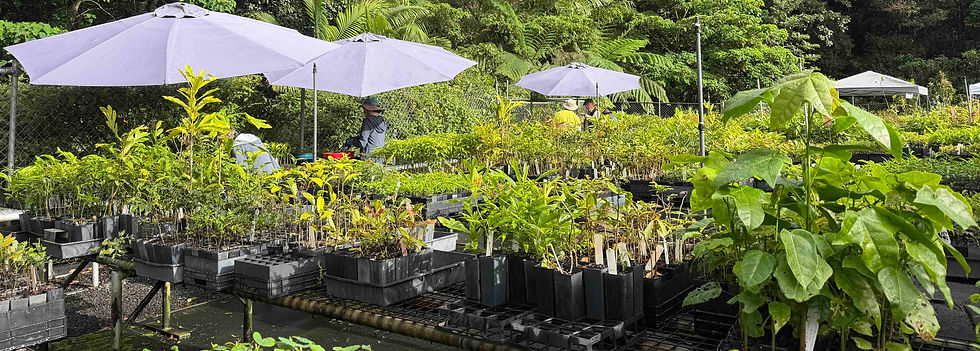
Spring has finally arrived, be that a little late, and the trees in the nursery are really picking up after the constant rain which was slowing their growth somewhat. After production being set back a bit last year due to staff disruptions, we are set to return to the level and quality of stock as it should be after this year. The trees are still looking on track to be in great condition for the upcoming planting season. Out in the field, trees from plantings in this and last year’s sites, are also looking absolutely fabulous.
Thankfully there was no frost to speak of this year, so no set-backs to report. As you will all know, the past couple of years have seen severe frosts at the Wongabel Conservation Area sites, causing extensive damage regardless of frost guards over the most vulnerable trees. So this year, after an early planting on the 7th February, and a huge effort from volunteers to install the frost guards just in case, the trees are looking fantastic and we shouldn’t need to plant any further trees within that site.
However, Reforest are sponsoring a further 1 ha planting, towards the northern end of the area in 2027. Organised by Bronwyn Robertson from Terrain, this will be the 3rd Reforest planting on the Wongabel Conservation Area, implemented and maintained by NQLMS. This a fantastic venture by the Reforest organisation, and it looks as though this partnership will continue into the future of this recovery project.
The 2025 – 2026 financial year was a very busy year for Restoration Services/ Lake Eacham Nursery with many visitors from all over the world coming to witness this amazing relationship between Government and the TREAT Community Revegetation Group. Yes, TREAT’s amazing morning tea has a world-wide reputation, but the achievements of this partnership have a much greater recognition.
Some of the visitors to the nursery over the past year include Taketo Tanigaki and 11 students from Ryukoko University in Japan. He has visited with students previously. They kindly donated to TREAT for their hospitality, practical experience and nursery tour. There was also a new intake of School for Field Studies students, who attended over 3 Fridays to experience some hands-on aspects of restoration work with TREAT and a tour of the nursery.
Ravenshoe High School students also attended the Visitor Centre, had a nursery tour and gained some practical experience with seed preparation, potting, plant sizing and weeding - hosted by TREAT volunteers of course. There are many situations behind the scenes where TREAT volunteers provide experience to many different groups such as these. This includes other schools, home school kids and people from information centres to gain a better insight into how TREAT works, what they achieve, how they do that, and then spread the word or share the knowledge gained through their visit to the facility.
The end of the financial year saw the TREAT AGM take place on the 4th September to not only vote in the new committee, but also to reflect on the past year’s achievements. Nigel Tucker was this year’s guest presenter. I was on leave at this time recovering from knee surgery, so Stephen McKenna presented the annual nursery report on behalf of QPWS/ Restoration Services. He also did a fantastic job as always, keeping the nursery running smoothly in my absence. This included the statistics for volunteer hours at tree plantings & pre-planting set-out, mid-week tree selection & mixing in the nursery, installing frost guards, site inspections, Display Centre and, topping them all, nursery production. Thanks to Rod Williamson for supporting Stephen and the nursery in my absence.
Here are the statistics:
2023-24 2024-25 2025-26
Volunteer hours at nursery and Display Centre
7,714 8,123 8536
2023-24 2024-25 2025-26
Seedlings potted up (repotted) 52,172 50,531 57,816 (9,991) (7,795) (11,099)
2022-23 2023-24 2024-25
Stock held at annual Aug/Sep stocktake (no. of trees) 70,000 70,000 80,000
In August, some further statistics were presented by TREAT President John Clarkson at the Australasian Plant Conservation Conference.
John’s presentation was titled ‘A Unique Partnership’. It spoke of the formation of TREAT in 1982 and working with QPWS and local landowners to grow and plant rainforest trees native to the Wet Tropics. It spoke of the experience gained in that time that has led to a good understanding of what species will do well in specific restoration projects. The presentation also included mention of the MOU between QPWS and TREAT, and the effective collaboration between the two organisations. This relationship between TREAT and QPWS is unique and not matched anywhere else in the state. It also illustrated some of TREAT’s successful projects and discussed the valuable role its members play in training and mentoring people from diverse groups within the local and broader community. We thank John for his effort in spreading the word of this collaboration and what we achieve together.
I also thank all of you for the amazing effort you have contributed again over the past year and, as always, look forward to the next year working together.

FRUIT COLLECTION DIARY July to September 2026
Species | Common Name | Regional Ecosystem | Collection Date |
|---|---|---|---|
Endiandra montana | Coach Walnut | 7.12.1, 7.8.2 | 01/07/26, 10/09/26 |
Endiandra sankeyana | Sankey’s Walnut | 7.8.2 | 17/09/26 |
Eupomatia laurina | Copper Laurel | 7.12.1 | 1/07/26 |
Flindersia acuminata | Silver Silkwood | 7.8.2 | 2/07/26 |
Flindersia pimenteliana | Maple Silkwood | 7.8.4, 7.8.2 | 27/08/26, 03/09/26 |
Harpullia rhyticarpa | Slender Harpullia | 7.8.4 | 24/09/26 |
Helicia lamingtoniana | Lamington’s Silky Oak | 7.8.2 | 14/09/26 |
Heptapleurum actinophyllum | Umbrella Tree | 7.11.12 | 3/09/26 |
Hicksbeachia pilosa | Red Bauple Nut | 7.8.2 | 3/09/26 |
Homalanthus novoguineensis | Bleeding Heart | 7.8.3 | 23/09/26 |
Litsea leefeana | Brown Bollywood | 7.8.2 | 23/09/26 |
Lomatia milnerae | Lomatia Silky Oak | 7.8.4 | 27/08/26 |
Species and Common names taken from the Queensland Herbarium Census 2024
Note synonyms: Acmena divaricata= Syzygium divaricatum, A. graveolens =S. graveolens, A. smithii=S. smithii, Heptapleurum actinophyllum=Schefflera actinophylla,
Waterhousea unipunctata=Waterhousea unipunctata